One of the most profound ways to regain control over our health is by recognizing that what we put into our bodies matters. Hippocrates famously said, “Let food be your medicine, and medicine be your food.” I’m no genius, but Hippocrates was on to something! Nutrition is the foundation for our health. We find ourselves healthy when nourishing our bodies with whole and natural foods. When we consume foods void of nutrients, we will eventually find ourselves lacking in health. Foods void of nutrients may include highly processed foods, foods with a long shelf life, foods containing synthetically derived flavours or preservatives, and foods with ingredients you’ve never heard of before, as a few examples.
In our home, we aim to avoid foods that fit into the category of being unhealthy. Of course, we are imperfect and occasionally eat foods we should avoid. But as a whole, we limit these types of foods in our day-to-day diet. When shopping at the grocery store, items must pass the ingredients test before entering my cart. My ingredients test looks like this: if I flip the package and read the label and cannot pronounce the ingredients or don’t know what they are, I put the item back on the shelf. Again, I’m not perfect here, but this is a test I use when buying food for our home.
You’ll discover quickly that only a few things will make their way into your cart when using this test. As consumers, we blindly trust that companies will not be selling us products that contain ingredients that could potentially harm us. Sadly, that isn’t the case. Many known ingredients are proven to be detrimental to our health, but they still find their way into our food. For a quick example, look into red food dye 40 (red 40, red dye 40). While a little bit isn’t going to kill us, the compound effect of it over a lifetime may be deadly. More information on that compound effect in a minute.
The even more frustrating thing is some food items, like bread, traditionally are only made with 4 or 5 ingredients: flour, yeast, salt, water, and optionally, some sweetener (like honey, for example). And sourdough bread can be made with just 3: flour, salt, and water. Yet when we go to the grocery store and look at a bag of sandwich bread, it has anywhere from 12 to 25 ingredients. Why are all the extra ingredients needed? They aren’t, of course, but they provide consistency in appearance, taste, smell, and prolonged shelf stability. All these things ensure the bread meets a quality standard set by the company that ultimately wants to reach sales targets.
Companies are okay to drive a higher profit for themselves at the expense of the consumer’s health. But, lucky for them, health issues won’t appear from eating poor ingredients once or twice; they might not even show up for decades! This is where we have to be aware that the choices we make in our diet will have a compound effect on our health, either for the better or worse. When we choose heavily processed foods void of all nutrition, those choices could compound sickness and disease. Of course, it’s not just from a few extra ingredients in the bread, either. It’s from the unnecessary ingredients in ALL the food we consume.
The good news is that our food choices can also compound in a positive way to improve our health. We need to choose better foods. In the example we are talking about here, bread, it means finding a bakery that you trust only uses real ingredients or perhaps baking your own bread at home.
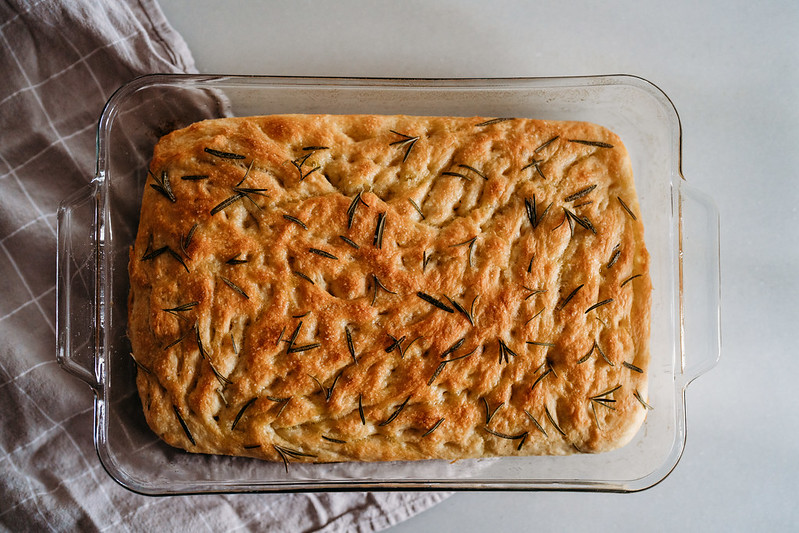
For many of you, the thought of baking homemade bread may be very daunting. I do recall the intimidation of baking my first loaves many years ago. But there are many, many ways to simplify this process. We have a bread maker that we utilize regularly for our homemade whole-grain loaves. We also have a local baker who makes the best sourdough bread. And occasionally, I feel inspired to make a homemade loaf with my hands, just because I can! It is delicious and rewarding, and I promise you it’s not nearly as difficult as you’d expect. I’m going to share a very beginner-friendly recipe for Focaccia. It does require a bit of rising time, but it doesn’t require any kneading. If you can combine ingredients in a bowl and stir, you can make this Focaccia! I have some other great bread recipes that I’ll share in the future!

Though this bread isn't shaped in a traditional sandwich loaf, it does make a wonderful bread for sandwiches. Cut a corner vertically and then horizontally through the middle to make two thinner slices of bread. Fill with your favourite sandwich delights!
Ingredients
Instructions
Notes
Simple Food, Real Ingredients will be an ongoing series on the blog. This first post includes a bit more information then subsequent posts will to give you a better understanding of the purpose behind the series. I hope you enjoyed and look forward to more posts in this series!

