
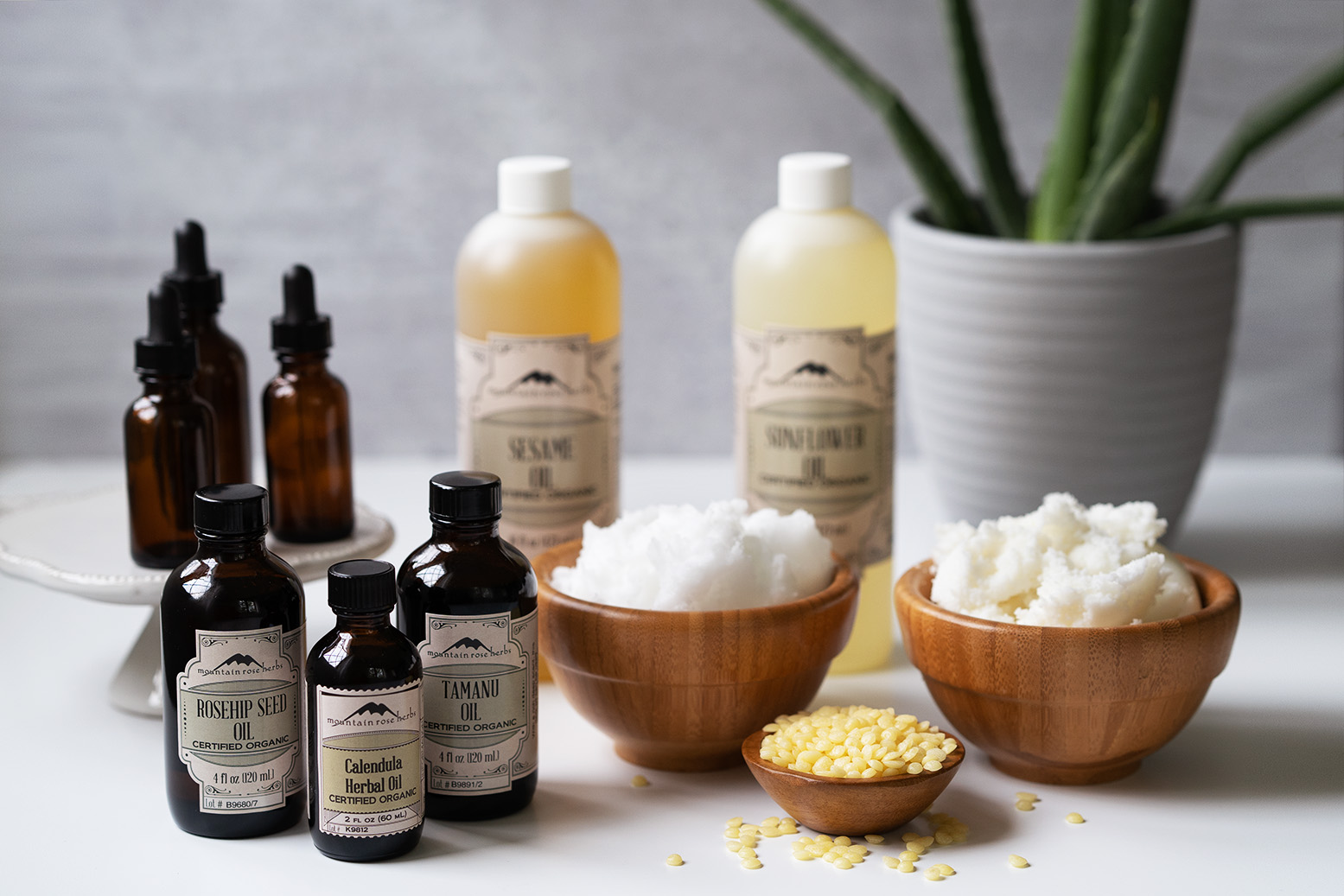
The term carrier oils is commonly used in the world of essential oils and aromatherapy, but if you’re just getting started with essential oils, all these terms can feel really overwhelming. I’m going to break down the basics of carrier oils, what they are, why we use them, some of the more common ones, and what to look for when buying them. While essential oils are typically the ‘star of the show’, don’t underestimate the power of a great carrier oil; they have their own incredible lists of healing properties that are worth exploring! Lately, I have found researching different carrier oils to be incredibly fun and eye-opening. I was previously of the mindset that essential oils had all the benefits and that carrier oils were simply a way to deliver them, but that is just so far from the truth!
WHAT ARE CARRIER OILS?
Carrier oils, or vegetable oils, are fatty-based oils. They can be thought of as your cooking oils — coconut oil, olive oil, almond oil, avocado oil, etc. Carrier oils come from the fatty portion of the plants such as the seeds, nuts, and even the fruits. The portions of the plant that are used to create these fatty-based oils are often cold-pressed, as using heat to extract the oils would damage the naturally occurring nutrients that can be found in these oils.
So, while you can raid your pantry and grab some cooking oil to use with your essential oils, ideally you’re looking for a cold-pressed version of these nut and seed oils. Vegetable oils marketed for cooking are not always extracted in ways that maintain the skin-loving nutrients of these fatty-based oils. Often times, cold-pressed carrier oils are marketed as ‘skin oils’, but be sure to read the label thoroughly to understand what you are purchasing.
HOW DO I USE A CARRIER OIL?
Carrier oils are used to dilute the essential oils that they are paired with, and gently carry them into the skin. While we often associated dilution as ‘watering down’ the initial product, when it comes to essential oils and carrier oils this isn’t entirely the case. Carrier oils do dilute in the sense that they are taking a very high-concentrated, powerful product (the essential oil) and diluting it in such a way that it slows the absorption of the essential oils into the skin and also allows essential oils to easily be applied over a larger surface area. However, carrier oils have their own set of amazing therapeutic actions and features — ranging from being anti-inflammatory, supportive to the collagen in the skin, wound healing, antimicrobial, antibacterial, skin softening, and many, many more properties depending on the oil you’re working with. When looking at how essential oils play into this mix, it is important to realize that the essential oils aren’t being ‘watered down’ in the way we might first think they are, and in some cases they will work even better in lower dilutions than in higher ones. Now I am the first to admit I’ve had a hard time wrapping my head around that concept — I’m previously from the belief that if a little is good, then a lot is better! However, when paired together in a thoughtful manner, carrier oils really complement the actions of essential oils, giving us a powerhouse for healing, nourishing, and supporting the skin and body.
CHOOSING THE RIGHT CARRIER OIL
As already mentioned above, if you’re wanting to achieve the maximum benefit from your carrier oil, you will want to make sure they have been extracted in such a way that the nutrients of the oil have been maintained. This is almost always through the cold-pressing of the nuts, seeds, and fruits. Some of the key words to look on a label for when buying a carrier oil are: cold-pressed, raw, virgin, and/or unprocessed. If purchasing carrier oils online, you can always reach out to the manufacturer to ask for more questions about how an oil was processed to ensure you’re getting a good-quality carrier oil suitable for the skin. Visiting a local health store would also be a good option and usually the staff would be able to help you find the right oil.
Like with essential oils, picking a carrier oil from a reputable company that stands behind a commitment to quality and high standards, is the most ideal. Choosing organic when it is an option is also the most desirable. These carrier oils may come at a bit higher price, but they are still very affordable. Remember, our skin is our largest organ, and high quality carrier oils are worth it, not only in their therapeutic, nourishing qualities on your skin and body, but the peace of mind that you’re using a product that is bettering your health, not hindering it.
A FEW OF OUR FAVOURITE CARRIER OILS
There are a few carrier oil ‘staples’ that I would recommend and I will list below. Keep in mind that carrier oils typically last from about 6 months to 1 year (depending on the oil). You will want to purchase your carrier oils with this in mind, so that you are not throwing away oils that have turned rancid. Luckily, many carrier oils are available for purchase in small bottles or containers, so not only can you get through them long before they expire, but you will also be able to experiment with a few at a time, and find your favourites for your skin. Keep in mind that we each have skin very unique to us as individuals, and what works for one person might not work for another. It is best to experiment with a few options to find which carrier feels and works best for you in different situations!
My last bit of advice is that a little bit of carrier oil goes a long way, especially when applying to the face. I typically use only 5-6 drops of a carrier oil (mixed with essential oils) on my entire face. We are so used to using large volumes of lotions and moisturizers, but working with carrier oils and essential oils is quite different. When applying to your skin, start with a little, working your way up as needed to avoid any greasy feeling on the skin.
Here are some of the commonly used carrier oils that are generally easy to find:
COCONUT OIL
Coconut oil is unique in that it is actually solid in temperatures below 24°C / 76°F. Once it reaches this temperature, however, it will be a liquid. If you stick it in the fridge or freezer, it will actually become quite hard. This characteristic makes it possible to make ‘creams’ with coconut oil, which in some situations, makes it easier to apply to the skin than a liquid carrier oil.
In its cold-pressed, or raw state, coconut oil should have a rich, coconut aroma to it. If it has undergone processing, or is refined, it will not have that same, recognizable coconut aroma. Almost 50% of coconut is made from a medium-chain saturated fatty acid called lauric acid. Lauric acid is antimicrobial, antiviral and antibacterial, supporting the body’s immune system. Coconut oil is also supportive to the skin in that it is both strengthening and softening, making it a great oil for stretch marks and improving the elasticity of the skin. Coconut oil is also great for anti-aging. It has naturally occurring vitamin A, D and K.
ALMOND OIL (SWEET ALMOND OIL)
Almond oil is light, soothing, and nutritious for the skin. Some of the nutrients in almond oil allow it to retain moisture and when applied as a carrier oil, these nutrients help protect water loss from the skin. Almond oil has anti-inflammatory properties, is boosting to the immune system, and overall incredibly healing for the skin, especially dry or damaged skin. Trace amounts of vitamins E and A can be found in almond oil.
JOJOBA OIL
Jojoba oil is not technically an oil, but rather a wax, due to the high quantity of wax esters and the very few triglycerides present in it. Jojoba oil looks like an oil, but acts in some ways like a wax. The unique nutrients that make up jojoba oil are very similar to the sterol content in our own skin. It provides a slight film over the skin, but at the same time allows the skin to breathe and will not clog pores. Jojoba is excellent for regenerating the skin, wound healing, helps treat acne, and even guards against bacteria and skin imbalances. It includes vitamins E and B.
SESAME OIL
Sesame oil is both anti-inflammatory and moisturizing for the skin, hair, and nails. It has characteristics that make it antibacterial against many skin pathogens and fungi. Sesame oil is easily absorbed by the skin and carries its healing properties with it to the deepest layers of the skin. Overall, it is an excellent all purpose skin oil that is high in antioxidants and vitamin E.
OLIVE OIL
Olive oil is commonly thought of as a cooking oil, but it has many skin benefits as well. Oleic acid is abundantly found in olive oil, making up approximately 70% of the oil. The oleic acid supports the natural breathing and sebum production of the skin. Olive oil is also very moisturizing and soothing for dry skin, and good for wound healing. Vitamins E and K are found in olive oil.
GRAPE SEED OIL
Organic grape seed often has a slightly darker colour and a light scent, whereas non-organic grape seed is typically light in colour, or clear, and offers little or no aroma. This oil is good for strengthening collagen, maintaining elastin, and overall helps support the connective tissue of both the skin and joints. Grape seed oil offers toning and tightening properties for the skin. It is high in the omega-6 fatty acid linoleum acid, making it a light oil that can easily penetrate the skin. This makes grape seed oil an excellent choice for formulating body and massage oils. Grape seed oil is high in vitamin E.
* * *
There are so many additional carrier oils beyond the few I have listed here. While it is best to get to know each carrier oil and how your skin reacts to it, you likely won’t find a ‘one-size’-fits-all’ approach to your carrier oils. For example, what feels really nice on your face might not be the best carrier oil to use in a muscle rub, or for a little one’s diaper cream. Please also experiment beyond the oils I have listed above, as exploring the world of carrier oils is very fun and rewarding! I would love to hear what your favourite carrier oils are and how you use them.

