
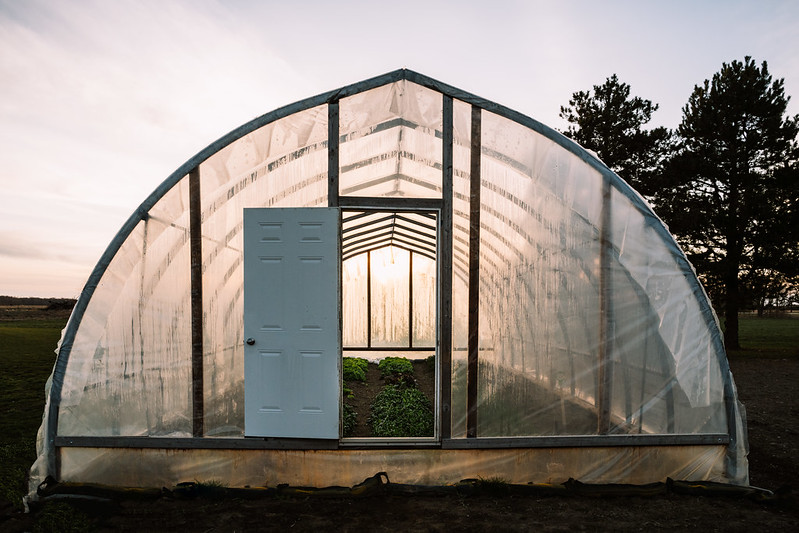
Even though it is the middle of summer at the moment, believe it or not, this is the time of the year to start thinking about what you want to grow in the wintertime! Next month (mid-August), I will plant our winter carrots, and shortly after, I will start to plant our cold-hardy greens. But before planting any seeds, I must determine where our greenhouse will sit for the winter. I will stake out the four corners, amend the soil, and build the beds and walk paths. I have already thought about what seeds I will need, and have ordered those a few months ago. So, it is a bit of a process! Just like a summer garden, prep work begins months in advance.
Since I have been asked questions about our winter gardening setup, I pieced together this post to act as a resource for anyone interested in this gardening method. I do not claim to have invented the concept of winter gardening, so let me start with the books that inspired me to take on this project.
Books

The Winter Harvest Handbook is my go-to resource! Several years ago, I read it cover to cover, devouring every page. Years before we purchased our greenhouse, I was reading this book and dreaming about how lovely it would be to harvest food in the middle of winter. I have used this resource to help determine anything from which greenhouse to purchase to which varieties of seeds to grow to how to space my planting beds and walk paths. It was all new to me, and having this book walk me through a tried and true method for growing winter vegetables was invaluable to me.
Four-Season Harvest: Organic Vegetables from Your Home Garden All Year Long, 2nd Edition

While I can’t say I’ve read Four-Season Harvest as thoroughly as the one above, I still use this book as a reference. It also covers winter gardening techniques and shares ways to build inexpensive structures for harvesting vegetables all winter. This book also covers gardening in all the seasons and is a fantastic reference book to have on hand for anyone who loves growing their own food.
The Four Season Farm Gardener’s Cookbook

Barbara Damrosch and Eliot Coleman wrote the Four Season Farm Gardener’s Cookbook. Barbara Damrosch is Eliot’s partner and has shared this wonderful collection of seasonal recipes in her cookbook. I am a sucker for a good cookbook and the fact that this one also includes some more tips and tricks for winter gardening by Coleman sealed the deal for me. It doesn’t have as many fine details about the ins and outs of winter growing, but there is a section at the start of this cookbook dedicated to gardening in all seasons. I have taken notes about plant varieties and timing for planting from this book. Do you need this book if you have the two listed above? No, probably not. But it does offer some additional resources and if you think you’d enjoy the cookbook as well then this book is a treat.
The Winter Market Gardener: A Successful Grower’s Handbook for Year-Round Harvests

I have yet to dive deeply into The Winter Market Gardener by Jean-Martin Fortier and Catherine Sylvestre. It is in my book stack, and I intend to read some parts this summer before I finalize what I will grow this winter. The authors run “Les Jardins de la Grelinette,” a self-proclaimed micro-farm in Quebec, Canada. This book has excellent reviews, and I can understand why after skimming through the pages. I am excited to dive in and will update you when I’ve had a chance to read more.
Structures
As you can see, I am a huge fan of Eliot Coleman! His farm is located in Maine and is now run by his daughter. The Maine farm, Four Season Farm, is in a 5a growing zone, which experiences slightly colder temperatures than we do. Since we are located in a 6a growing zone, growing vegetables should also be possible year-round.
I read the first book I shared above, “The Winter Harvest Handbook,” cover to cover and came up with our initial plans for our greenhouse. In his book, Coleman shares his own resources for hooped structures, seeds suppliers, gardening tools, etc., which are a beneficial starting point. However, most, if not all, of the companies are American. Since I am in Canada, I had to find suppliers here.
Let’s first start with the structure we went with. I want to preface that you do not need a large greenhouse structure to grow vegetables effectively in the winter. There are many other options for covering existing garden beds and building smaller DIY structures. However, I knew I wanted a larger, semi-permanent structure, and we were fortunate enough to be able to go this route financially. The company we purchased from is located in Ontario, Canada, called Multi Shelter Solution.
Multi Shelter Solutions offers “skis” for moveable structures, which were essential to my winter gardening approach. Information on movable structures can be found here. Since we do not want the greenhouse in the exact location each winter, the skis allow us to drag it to different places.
As mentioned above, Multi Shelter Solutions are located in Ontario, only a few hours from our farm, so our delivery costs were manageable.
The only downside for us was assembling the structure. It came with very little instruction (though there are many resources online, almost too many videos and things to read through). It was a massive learning curve since we had never built anything like this. But thanks to my incredibly dedicated husband, we were able to get it built. And if we were to want to build a second greenhouse for any reason, I believe it would come much easier the second time around.
Structure Plastic
We placed a single layer of infra-red plastic over our structure. When we were ready to purchase our greenhouse, I found out that there are many options for the type of plastic you can use and how many layers to put on. Double-walling plastic is quite common in unheated greenhouses. You’d have one layer of plastic on the outside of the structure and another layer of plastic on the inside of the frame. This creates a pocket of air between the two layers and extra insulation. In theory, this sounds like it would be suitable for winter growing. More insulation would mean it is warmer inside. However, it also limits the amount of light entering the greenhouse. Since we specifically use winter-hardy vegetables that will continue to grow in the winter if they get enough light, we do not necessarily want the additional warmth, especially if it compromises the amount of light. So, we have chosen extra light over warmth, and I am convinced we made the correct decision.

Roll-Up Sides
Our greenhouse has roll-up sides or curtains. I leave them closed all winter and open them on warmer days in the spring. Since all the plants are cold-hardy, I need to keep the environment inside the structure cooler when the sun gets hotter in the spring. Many of the leafy greens will bolt (go into seed) if it gets too warm, so opening the sides allows me to control the temperature and also allows air circulation inside the structure.
Structure Size
Our greenhouse is 20 x 40 feet. We are a family of five, and I have many farm animals to feed any extras to. This seems to be more than large enough for our needs. However, we have yet to go through an extremely cold winter. Our last two winters have been mild; thus, the greens have continuously grown all winter. I suspect that in a cold winter, the leafy greens would come back significantly slower after each cutting. I will continue to plant the entire greenhouse, minus 5 feet at the front for tools, pails, bowls, etc., and 1 foot at the back for room to place my row covers when they aren’t over the plants. I also wanted enough space to continuously experiment with different crops without taking away from the option to grow the crops we already enjoy.

I hope the information has helped explain why we chose the physical structure/greenhouse options that we did. Also, I keep calling it a greenhouse, but I realize it is likely more commonly called a hoop house or high tunnel. Greenhouse has been the term we’ve used since day one, correct or not, and it has stuck!
Below are some additional resources we have acquired to help you start your winter gardening experiments.
Seeds – Varieties and Canadian Suppliers
I am in the early stages of figuring out what we like to grow in the winter. After our first winter, I realized we needed more leafy green varieties to make our own mixed green salads. So, we added several cold-hardy greens to our garden last winter. Most importantly, we always need to grow what we will eat. For example, I grew a lot of mizuna in the first year because it was exceptionally cold-hardy, but I had no idea what to do with it in the kitchen. As a result, most of it went to the chickens and cattle. I am now focused on growing the things we enjoy eating, with some experimentation mixed in.
We also utilize a lot of spinach in the winter months, so I tend to plant a lot of that. Carrots are another vegetable we have had success with and thoroughly enjoy eating in the winter. We will continue with these selections try new vegetables and varieties as we are ready.
Here are a few of the varieties we are growing:
- Carrots – Napoli
- Spinach – Space
- Claytonia (Miner’s Lettuce)
- Lettuce – Coastal star
- Lettuce – Salad bowl
- Lettuce – Grand Rapids
- Lettuce – Rouge D’hiver (Romaine)
- Arugula – Astro
- Pac Choi – Toy Choi
- Beets – Red Ace (use greens in baby mixed salads)

I’ve used both West Coast Seeds and Veseys regularly. I have recently been leaning towards ordering from Veseys, though, as their shipping times are much, much faster than West Coast Seeds. Usually, Veseys has their order to me within a week, while I have waited 2-3 weeks at times for West Coast Seed orders. I have been happy with both companies’ seed and product quality.
Garden Layout
I built up five beds in my greenhouse to grow crops and have walking paths between each row. The inner beds are 30 inches wide, and the outer beds are 24 inches wide. The walking paths between each bed are 18 inches wide, and I also keep approximately 12-18 inches between the outside beds and the “walls” of the greenhouse structure.
To simplify, our layout goes something like this:
- Greenhouse wall
- 18-inch buffer
- 24-inch growing bed
- 18-inch path
- 30-inch growing bed
- 18-inch path
- 30-inch growing bed
- 18-inch path
- 30-inch growing bed
- 18-inch path
- 24-inch growing bed
- 18-inch buffer
- Greenhouse wall
Row Covering
On nights that dip below -10C, I give our plants additional coverage from the cold. Erik has bent me some wire rod supports to push into the ground over the top of the rows. You can see them under the row cover in the photos below. Then, I clip some lightweight row covers directly over the top of the plants. The following morning, I will remove the row cover from the plants (if the temperatures have increased) to allow maximum sunlight to reach the plants.

Sometimes, I will leave the row cover over the plants for a few days straight. One winter, we had -20C wind chills for 5-6 days, and I left the plants covered the entire time. They didn’t seem to be negatively affected by this. On the contrary, one night, the temperature unexpectedly dipped below -20C, and I didn’t have any plants covered; I did notice some damage to the leaves from nearly everything in the greenhouse. Thankfully, nothing died from that cold exposure. But it was a reminder to watch the low temperatures forecasted for the night.
I have used West Coast Seeds’s “Lightweight Floating Row Cover” for the last two years. I purchased the 100’ length and cut it to size, using the 7’2” width to ensure complete coverage down to the soil. West Coast Seeds has been out of stock on this item for some time, and I needed to replace my row cover fabric for this coming winter. I have purchased Veseys‘ “Floating Row Cover” in the Ag-17 option, which provides frost protection down to -2C while allowing 85% light transmission.
Conclusion
I hope this information has been helpful for you to get started on your winter gardening adventure! I do not claim to be an expert in this area, but I have no doubt my experiences will be a helpful starting point for many. I highly recommend checking out Eliot Coleman’s books as listed above. All the information I have learned over the years has come from those books. They are an essential starting point for winter gardening in colder regions. If you have additional questions, please never hesitate to reach out, and I am happy to help where I can.
I want to close with one final thought. Winter gardening has been, by far, my favourite gardening experience. There is something magical about bringing a bowl of fresh baby green salad into the house to be enjoyed in the depths of winter. This has been good for my soul in so many ways beyond the fresh food at our table. I would love to extend that experience to others so you, too, can nourish yourself and your family with the gifts that nature has to offer in the wintertime. In so many ways, we have been made to believe that we cannot feed and take care of ourselves and our families. But it is possible, and it can start in effortless ways. Our first winter gardening didn’t involve a fancy greenhouse; it simply involved planting cold-hardy carrots and over-wintering them in our garden, adding straw mulch for protection, and digging them out of the garden as needed. My hope is that you can find some inspiration in our journey to start experimenting for yourself and enjoying your own produce fresh on your table in the winter! Happy gardening!


